
family safety guide
Consent-Based Location Sharing: The Conversation Before Anyone Hits Share
 Jordan Hale· Privacy Editor· Updated August 27, 2026· 15 min read
Some links on this page may earn GUIDEORA a commission. Disclosure

Quick take
Consent-based sharing means the person whose location appears chose the audience, the precision, and the window. It is not a parent silently installing a tracker. HeyPolo is built around that idea as they currently document it: exact, general area, or private; time-limited, repeating, or always-on. Life360 and Find My can also be used consensually — the conversation is the product, not the logo. GUIDEORA will not treat covert tracking of kids who did not agree as a feature.

The map is the last step, not the first
Family locators sell a screenshot: smiling pins on a clean map. The screenshot skips the only part that determines whether the household will still be speaking in six months. Someone is about to see where someone else is. That is intimate even when the pin is 'school parking lot.' If you skip the talk, the app becomes a fight about trust wearing a safety costume.
The conversation is not a legal seminar. It is four questions out loud. Who is invited. How precise. How long. What happens when someone needs the pin off. Write the answers down. Then look at whether the app can do those four things without a workaround. If it cannot go private without a confrontation, it will get deleted. If it cannot do general area instead of a street, some people will never join.
From the record
Safety that requires secrecy from the person being located is not a family plan. It is a different product, and GUIDEORA will not dress it up as care.
GUIDEORA consent rule for locators
4 questions
Who, how precise, how long, how to pause
Two-way
Adults share if they ask kids to share
No hide
We will not coach covert installs
Consent is specific, not a vibe
Consent here is not 'we are a close family.' It is this person, this audience, this precision, this window, and the right to change any of those without being accused of hiding a crime. A share that was agreed for a late drive home is not a share for a Saturday in another city unless someone said so. Recurring commutes can be a repeating window. A vacation can be a dated window. Always-on is a choice, not a moral default.
Revocation has to be real. If turning sharing off triggers a household inquisition every time, people will leave location on and lie with their feet — or they will factory-reset the phone. Products that show private mode as a first-class control are matching how adults already live. Products that only offer all-or-nothing make the all-or-nothing fight inevitable.

Opt-in share
Required
Precision knobs
Exact / area / off
Time windows
Not forever
Private mode
No lecture
Two-way map
Adults too
Children and teenagers who did not agree
Young children do not sign privacy policies. Caregivers still owe them a version of the talk they can understand: we will see when you get to school; we will not watch you on the playground minute by minute; you can ask us to turn this off when you are home. Teenagers who can have a bank login can have a location conversation. If they did not agree, installing a locator and hoping they never find it is covert tracking. This site will not call that a safety feature.
Two-way sharing is the adult test. If a parent demands a live pin and keeps their own location off, the product is a hierarchy, not a household map. Many families still choose more precision for a new driver than for a parent at work. That can be fair if it was named. Unnamed double standards show up later as deleted apps.
Exact, general area, private — use all three
HeyPolo currently documents three precision levels: exact location, general area, and private mode. Exact is for the nights you already would have texted a pin. General area is 'I am in this part of town' without a street number. Private is off the map. Sharing duration, as they currently describe it, can be a timer, a repeating window, or always-on. Those knobs are the reason this guide uses HeyPolo as the example rather than treating every locator as the same blob.
Find My can share among Apple IDs. Life360 can share inside a circle and adds a larger safety stack (crash detection, roadside, a free tier, driving reports — say that honestly). Neither fact replaces the conversation. If your household is mixed iPhone and Android, Find My will not cover everyone. If your household wants a map that currently documents not selling location to advertisers, read HeyPolo's live privacy language — that is their claim, not a GUIDEORA audit.
Match the knob to the hour — not to a slogan.
| Situation | Precision that usually fits | Window | Skip if |
|---|---|---|---|
| New driver, first months | Exact on the commute | Repeating school/work hours | They never agreed |
| Adults in one house | Area or exact at home only | Evenings / arrivals | You want a documentary |
| Medical or job visit | Private | Until they turn it back on | You punish private mode |
| Trip in a new city | Exact among the travelers | Dated trip window | Bystanders did not opt in |
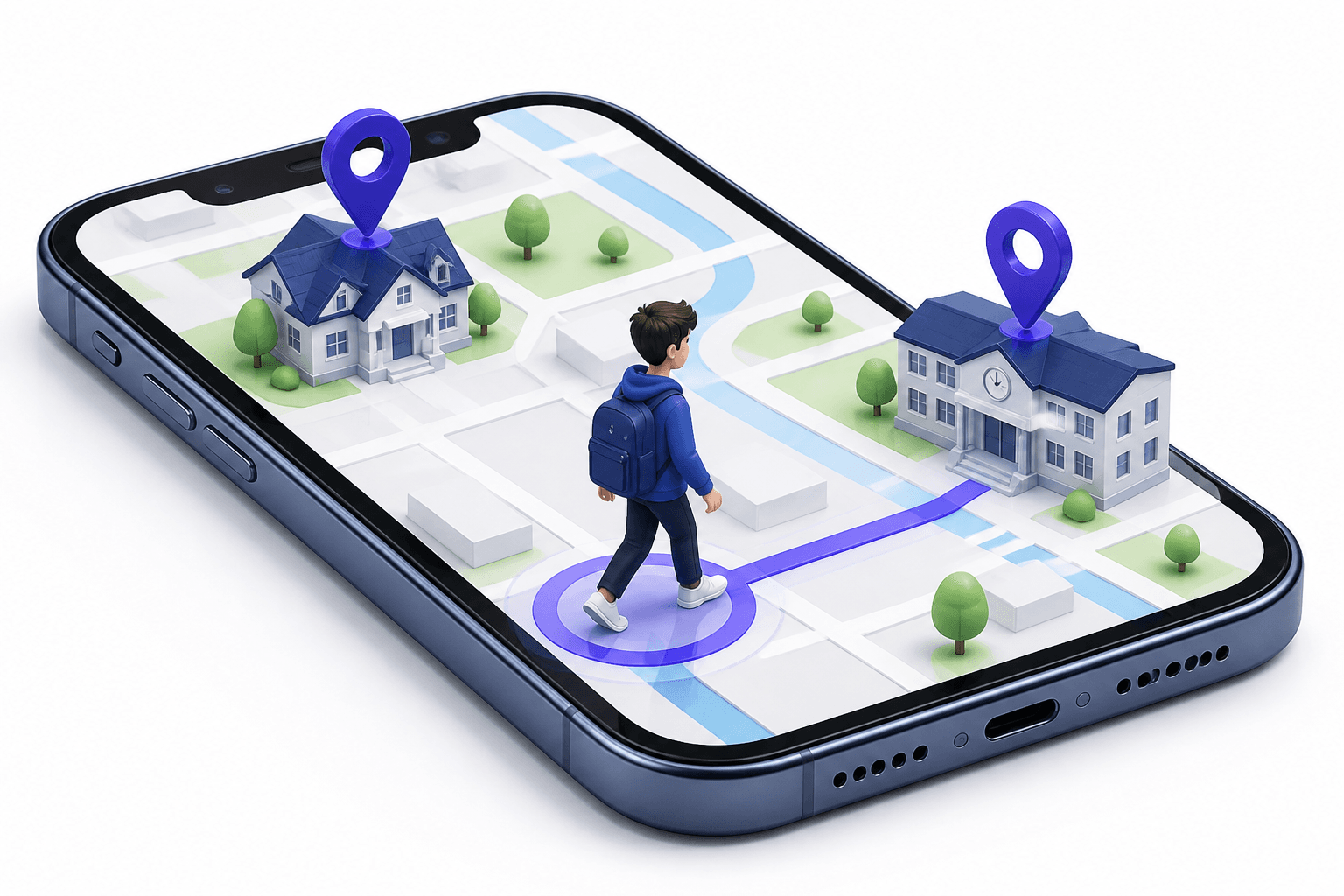
A first-week script that does not sound like a contract
- Sit down with the people who would appear on the map. No surprise installs.
- Name two places for arrival alerts. Add a third only if you still want it after a week.
- Adults share if they are asking others to share. Say the double standard if you insist on one.
- Practice private mode once on purpose so it is not a crisis the first time it is used.
- Pick one app. HeyPolo is the consent-and-privacy example this site features; confirm modes and price on checkout.
Pros
- +Written rules prevent the app from becoming the argument
- +Precision and time windows let people stay in the household without living on camera
- +Two-way sharing keeps adults honest
Cons
- −Consent takes an evening; an impulse install takes a minute
- −A vendor privacy page can change — re-read it
- −No locator replaces a phone call when something is actually wrong
Install only after the answers exist
If you cannot say who sees what, you are not ready to share location. If you can, pick a product whose controls match the paper. HeyPolo currently lists unlimited members on one plan, iPhone and Android, arrival and battery alerts, SOS as a family ping (not 911), and a 30-day money-back window as advertised. Trial lengths they currently advertise are 3 days monthly / 7 days annual. Checkout always wins. GUIDEORA is not HeyPolo and does not sell anyone's movements.
Editor take

The talk is the setup
Have the conversation, then pick a map that can honor the rules you wrote. HeyPolo is the privacy-shaped example this site uses. Do not install anything on a phone whose owner was not in the room. Confirm current sharing modes on the vendor's site — GUIDEORA is not the vendor.